
India is among the three least-favoured Asian stock markets, according to BofA Securities whose survey found that 10 per cent of fund managers are underweight on Indian equities from a 12-month perspective.

From the Sensex firms, Tata Motors, Titan, Eternal, Power Grid, Tata Steel, Larsen & Toubro, Mahindra & Mahindra and Hindustan Unilever were among the biggest laggards. Bajaj Finserv, Asian Paints and Tech Mahindra were the gainers.

'There is responsibility to make great games that are played by audiences, that fill the gap from an entertainment perspective.'

Nestle surged 4.25 per cent after the FMCG major reported 4.94 per cent increase in net profit at Rs 688.01 crore for the quarter ended December 31, 2024. IndusInd Bank, Titan, Tata Motors, Tata Steel, ITC and Maruti were the other major gainers. ITC Hotels, Bharti Airtel, Bajaj Finserv, Bajaj Finance and ICICI Bank were among the laggards.

Analysts are warning of growing risks to the market's sustained momentum, and even to the possibility of consolidation at current levels. Domestically, markets are grappling with several challenges, including a slowing economy, as indicated by the latest GDP data for the July-September (Q2) quarter of 2024-25 (FY25), sticky inflation, fluctuations in the rupee, waning consumption, and high interest rates.

The AV Birla group flagship Grasim Industries has been an outperformer on the bourses. The company's stock price is up 56.5 per cent in the last

Only experienced investors with a high risk appetite, a grasp of market cycles, and comfort with volatility and timing risk should invest.

The current spurt in the stock market is on account of strong fundamentals and robust corporate earnings and retail investors can look for buying opportunities to accumulate quality stocks, experts said.

While most investors brush off NFOs like spam, some of them offer solid opportunities, especially when you know what to look for. So let's clear the confusion around NFOs and figure out when they're worth your money, and when they're not.

The Reserve Bank of India's (RBI's) interest rate decision, West Asia conflict and trading activity of foreign investors are the key factors that will dictate investors' sentiment in the market this week, analysts said. Moreover, quarterly earnings from IT bellwether TCS, domestic macroeconomic data and movement in global oil benchmark Brent crude would also guide trends in the market. Worsening tensions in the Middle East and foreign fund outflows were the major culprits behind the equity markets sharp fall last week.

For investors who missed the initial IPO frenzy, the market correction is an opportunity to selectively invest in promising names, but patience and careful evaluation remain the key.

After investing a staggering amount in May, foreign investors turned net sellers with a withdrawal of Rs 8,749 crore from the Indian equity markets in the first week of this month triggered by renewed US-China trade tensions and rising US bond yields. This momentum follows a net investment of Rs 19,860 crore in May and Rs 4,223 crore in April, data with the depositories showed.

Shares of Tata Technologies, an arm of Tata Motors, made a dream stock market debut on Thursday, listing with a huge premium of 140 per cent, against the issue price of Rs 500. The stock of the company which provides engineering and product development digital services listed at Rs 1,199.95, registering a sharp jump of 139.99 per cent from the issue price on the BSE. It further zoomed 180 per cent to Rs 1,400.

618 companies were part of the billion dollar club when the markets reached all-time highs on September 26, 2024. That number has fallen to 500 following a $1 trillion wipeout in India's market capitalisation amid relentless selling by FPIs.

The country's largest listed gold jewellery maker, Titan Company, maintained its growth pace in the April-June quarter of 2025-26 (FY26).

A sharp fall in the equity market made investors poorer by Rs 5.29 lakh crore on Tuesday when the BSE benchmark Sensex tumbled over 800 points. A host of negative triggers -- muted quarterly earnings, continuous foreign fund outflows and weak trends in Asian and European markets -- dragged the benchmark indices lower. The BSE benchmark gauge tumbled 820.97 points or 1.03 per cent to settle at 78,675.18.
A sharp rally in domestic stocks from June lows has once again rendered Indian markets expensive to their emerging-market (EM) peers. The 12-month forward price-to-earnings (P/E) multiple for the Nifty50 Index is around 20.6x - 82 per cent higher than 11.3 per cent for the MSCI EM Index. India's valuation premium has hit a five-month high. This is on the back of sharp outperformance to EM and global peers from June lows and also due to earnings downgrades, following the April-June quarter of 2022-23 earnings.

The National Stock Exchange (NSE) has offered to pay Rs 1,388 crore to the Securities and Exchange Board of India (Sebi) to settle the colocation and dark fibre cases, potentially clearing the way for its much-awaited initial public offering (IPO). This is the biggest-ever settlement plea made with the markets regulator.

Foreign investors continue to exhibit confidence in the country's equity market, injecting Rs 19,860 crore in May driven by favourable global economic indicators and strong domestic fundamentals. This positive momentum follows a net investment of Rs 4,223 crore in April, data with the depositories showed.

Office space owners are looking at good times ahead as rentals are expected to rise due to demand for Grade A office spaces outpacing supply that has been sluggish due to construction delays, long gestation periods and developers' interests shifting to residential.

Investors' wealth on Monday surged Rs 4.21 lakh crore as markets bounced back after five days of fall. The BSE Sensex jumped 602.75 points or 0.76 per cent to settle at 80,005.04. During the day, it surged 1,137.52 points or 1.43 per cent to 80,539.81.

Of the top 10 valued firms, eight including Reliance Industries, Tata Consultancy Services (TCS), HDFC Bank, Hindustan Unilever Ltd, HDFC and ITC witnessed gains in their market valuation. From the top-10 pack, the valuation of HDFC Bank jumped Rs 31,553.45 crore to Rs 929,752.54 crore.

Retail investors have become a force to reckon with in the last 10 years with their ownership of Indian equities rising 800 basis points, or 8 per cent, to 23.4 per cent during this period, suggests a recent note from Morgan Stanley. This number, Morgan Stanley said, is set to rise in the next few years as Indian households are still underinvested in equities. India's demographics, policy framework, investor education and modest positive real rates, it said, will fuel the 'equity cult' in India.

'We emphasise the importance of not basing investment decisions solely on electoral outcomes.' 'Instead, focusing on investing in high-quality businesses capable of prospering regardless of the political landscape is paramount.'

The value of the Indian Premier League went up 6.5 per cent to USD 16.4 billion (around Rs 134,858 crore) in 2024, according to a report by American investment bank Houlihan Lokey.

Equity benchmark indices are facing massive corrections, with the NSE Nifty declining over 14 per cent from its lifetime high hit in September last year due to several negative triggers like stretched valuations, foreign fund exodus, disappointing quarterly earnings and rising global trade tensions dragging markets lower. The BSE benchmark Sensex hit its record peak of 85,978.25 on September 27 last year, and the Nifty also reached a lifetime high of 26,277.35 on the same day.

The Delhi high court on Friday stayed a Rs 1,140 crore angel tax demand raised by the Income Tax department from hospitality and hotel aggregator Oyo's parent company Oravel Stays Private Limited for the assessment year 2020-21. The tax demand was issued under Section 56(2) (viib) of the Income Tax Act, commonly known as the "angel tax" provision, which applies when unlisted companies issue shares at a value exceeding their "fair" market price.

Largecap, flexicap, and balanced advantage funds together recorded a net inflow of Rs 9,363 crore in August, representing a 70% increase from the previous month's total.

The stock of commercial vehicle (CV) company Ashok Leyland is up 46 per cent in the past three months, gaining despite worries about a slowdown in sales volume. Brokerages have a mixed view on the country's second-largest medium and heavy commercial vehicle manufacturer. The company reported steady March quarter results and its valuation, focus on growth and medium-term prospects are positive, but some brokerages are cautious, given near-term demand concerns and the risk of competition increasing in the industry.
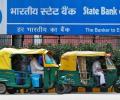
State Bank of India (SBI), the largest lender in the country, has launched a share sale to institutional investors to raise upto Rs 25,000 crore, the biggest qualified institutional placement (QIP) so far by an Indian firm, and has set a floor price of Rs 811.05, which is at a 2.5 per cent discount on Wednesday's closing price.

Among Sensex firms, Asian Paints, Bajaj Finance, Tata Steel, Bajaj Finserv, ICICI Bank, Maruti, Reliance Industries, HDFC Bank and Mahindra & Mahindra declined. Tech Mahindra, Tata Motors, Infosys, HCL Tech, IndusInd Bank and UltraTech Cement were among the gainers.

From the Sensex pack, UltraTech Cement, Infosys, Bajaj Finserv, Axis Bank, HDFC Bank, Bharti Airtel, HCL Tech and Tata Consultancy Services were the biggest gainers. Zomato tanked nearly 6 per cent followed by IndusInd Bank which declined about 5 per cent. Adani Ports, Mahindra & Mahindra, Reliance Industries and Sun Pharma were also among the laggards.

IndusInd Bank, Nestle, UltraTech Cement, Mahindra & Mahindra, Power Grid, Asian Paints, Sun Pharma and Tech Mahindra were also among the laggards. Bajaj Finance, Bharti Airtel, ICICI Bank, Adani Ports and HCL Tech were among the gainers.
'The long-term impact of elections is minimal.'

Domestic equity investors' wealth eroded by more than Rs 4.43 lakh crore on Monday as fears of a financial contagion triggered by one of the biggest bank failures in the US roiled market sentiments. After a strong opening, Indian stocks went into a tailspin with the benchmark 30-share BSE Sensex tumbling nearly 900 points to close at 58,237.85 points -- sliding for the third straight trading session. The NSE Nifty too declined 258.60 points to end at 17,154.30 points.

The Adani Group plans to invest a record $15-20 billion across businesses over the next five years to chart out the next phase of growth, chairman Gautam Adani said on Tuesday as he touted the conglomerate's strong balance sheet and robust business to shrug off relentless scrutiny it faces. Record earnings from the businesses ranging from seaports to airports, renewable energy parks to data centres, cement to gas and electricity has built India's largest infrastructure group that not only exists just to serve the markets but to serve the nation's destiny, he said.

Trends in the global energy markets are crucial if India's growth outlook is to remain healthy. Prices for the Indian crude basket were averaging around $86.2 per barrel through Q1FY25 and then moderated to $84 in July and to $78-79 in August (so far). But global crude supply may outpace weak global demand in the short term.
Pre-initial public offering (IPO) allotments have lost favour amid buoyancy in the market and increase in average float size this year. After hitting a record high in 2023, they have come to a halt, with just three companies opting for such placements totalling Rs 235 crore. This compares to eight deals worth Rs 648 crore during the same period of the previous year.

Investors lost Rs 24.69 lakh crore in market valuation in the last four days of severe drubbing in the equity market. Spike in global crude prices, unabated foreign fund outflows, a strong US jobs data diminishing early rate cut expectations, and the rupee logging its steepest single-day fall in nearly two years dampened investors' sentiment.

The tailwind of low price erosion in the US generics market, seen by domestic pharmaceutical companies in calendar year 2023 (CY23), may be reversing slowly, caution analysts. According to the latest data from US-based Centers for Medicare and Medicaid Services (CMMS), price erosion in calendar year 2024 (CY24) on a year-to-date (YTD) basis stood at a high of 15 per cent in the oral solid dosage (OSD) segment compared to a low of 1 per cent in CY23. This erosion, according to a report by Antique Stock Broking, was the highest in the last three years.
